MAGIC Project
Despite the ecological and economic importance of the Rías Baixas, there are many unknowns regarding the variability of primary production and the formation of harmful algal blooms. The MAGIC project seeks to find the answers.
The hypotheses
Hypothesis 1
Long-term trends in productivity of the Rías are controlled by regional atmospheric-ocean processes that influence the duration of the upwelling pulses.
Hypothesis 2
Differences in the response time of hydrodynamics to wind forcing and the duration of the upwelling pulses cause variability in primary productivity among the Rías.
Hypothesis 3
Lower turbulence and increased stratification promote the higher persistence of thin phytoplankton layers in Ría de Pontevedra.
Hypothesis 4
Rapid advection of surface populations from the shelf into the Ría de Pontevedra explain the higher persistence of harmful dinoflagellates in this bay.
The objectives
1.
To describe the temporal variability scales of chlorophyll-a in the four Rías Baixas, the shelf and the slope, and to investigate its relationship with meteorological and oceanographic variables.
2.
To compare the response time of hydrodynamics to wind forcing and the duration of the upwelling pulses among the Rías.
3.
To compare the production of turbulent kinetic energy and stratification.
4.
To compare the vertical distribution of chlorophyll-a.
5.
To compare the particles exchange between the shelf and inner Rías.
6.
To identify the main environmental triggers of harmful algal blooms (HABs) formation.

Image of the ‘Scientists meet Artists’ initiative organised by Campus do Mar and CIM. Author: Pablo Rosendo
The methodology
Data and observations
Analysis of time-series data from monitoring programmes and remote sensing, together with observations from previous oceanographic cruises.
Advanced analysis
Application of statistical tecnhiques and AI to study the spatiotemporal variability of physical-biological processes.
Numerical modelling
Simulations using the CROCO-PISCES oceanographic model to evaluate different environmental and wind forcing scenarios.
Integrated approach
Combination of observations, analysis and models to obtain a comprehensive view of the system.
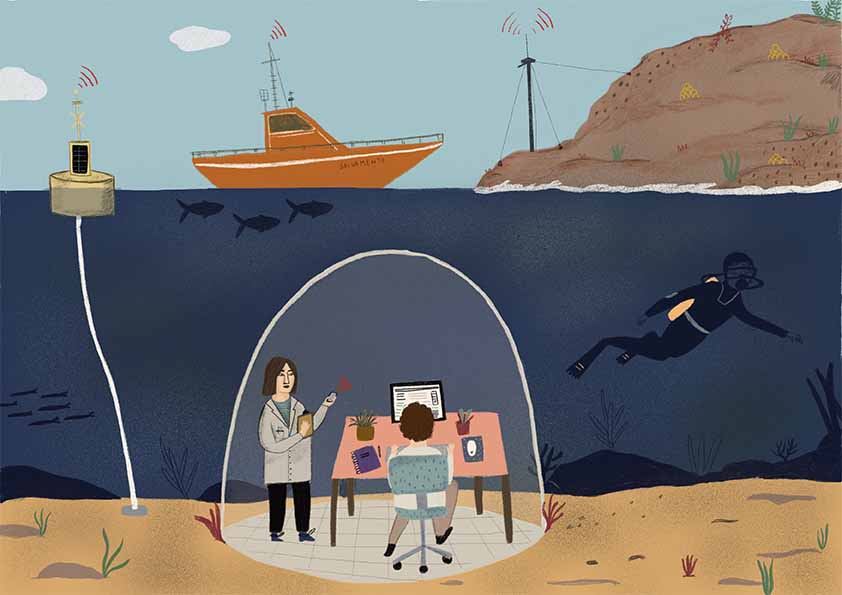
Image of the ‘Scientists meet Artists’ initiative organised by Campus do Mar and CIM. Author: Laura Trova
The partners